Our Oceans Are Turning into Plastic… Are We?

Ed note: This story was originally published in the November 2006 issue.
Fate can take strange forms, and so perhaps it does not seem unusual that Captain Charles Moore found his life’s purpose in a nightmare. Unfortunately, he was awake at the time, and 800 miles north of Hawaii in the Pacific Ocean.
It happened on August 3, 1997, a lovely day, at least in the beginning: Sunny. Little wind. Water the color of sapphires. Moore and the crew of Alguita, his 50-foot aluminum-hulled catamaran, sliced through the sea.
Returning to Southern California from Hawaii after a sailing race, Moore had altered Alguita’s course, veering slightly north. He had the time and the curiosity to try a new route, one that would lead the vessel through the eastern corner of a 10-million-square-mile oval known as the North Pacific subtropical gyre. This was an odd stretch of ocean, a place most boats purposely avoided. For one thing, it was becalmed. “The doldrums,” sailors called it, and they steered clear. So did the ocean’s top predators: the tuna, sharks, and other large fish that required livelier waters, flush with prey. The gyre was more like a desert–a slow, deep, clockwise-swirling vortex of air and water caused by a mountain of high-pressure air that lingered above it.
The area’s reputation didn’t deter Moore. He had grown up in Long Beach, 40 miles south of L.A., with the Pacific literally in his front yard, and he possessed an impressive aquatic résumé: deckhand, able seaman, sailor, scuba diver, surfer, and finally captain. Moore had spent countless hours in the ocean, fascinated by its vast trove of secrets and terrors. He’d seen a lot of things out there, things that were glorious and grand; things that were ferocious and humbling. But he had never seen anything nearly as chilling as what lay ahead of him in the gyre.
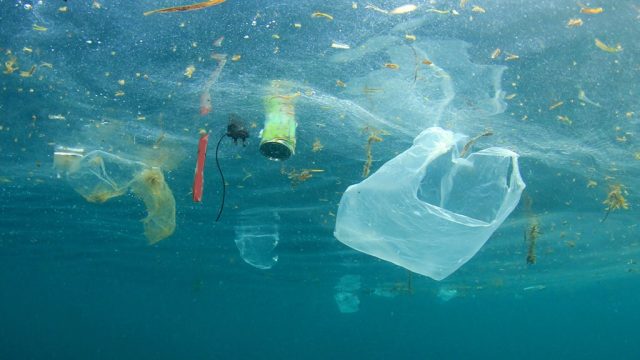
It began with a line of plastic bags ghosting the surface, followed by an ugly tangle of junk: nets and ropes and bottles, motor-oil jugs and cracked bath toys, a mangled tarp. Tires. A traffic cone. Moore could not believe his eyes. Out here in this desolate place, the water was a stew of plastic crap. It was as though someone had taken the pristine seascape of his youth and swapped it for a landfill.
How did all the plastic end up here? How did this trash tsunami begin? What did it mean? If the questions seemed overwhelming, Moore would soon learn that the answers were even more so, and that his discovery had dire implications for human–and planetary–health. As Alguita glided through the area that scientists now refer to as the “Eastern Garbage Patch,” Moore realized that the trail of plastic went on for hundreds of miles. Depressed and stunned, he sailed for a week through bobbing, toxic debris trapped in a purgatory of circling currents. To his horror, he had stumbled across the 21st-century Leviathan. It had no head, no tail. Just an endless body.
“Everybody’s plastic, but I love plastic. I want to be plastic.” This Andy Warhol quote is emblazoned on a six-foot-long magenta and yellow banner that hangs–with extreme irony–in the solar-powered workshop in Moore’s Long Beach home. The workshop is surrounded by a crazy Eden of trees, bushes, flowers, fruits, and vegetables, ranging from the prosaic (tomatoes) to the exotic (cherimoyas, guavas, chocolate persimmons, white figs the size of baseballs). This is the house in which Moore, 59, was raised, and it has a kind of open-air earthiness that reflects his ’60s-activist roots, which included a stint in a Berkeley commune. Composting and organic gardening are serious business here–you can practically smell the humus–but there is also a kidney-shaped hot tub surrounded by palm trees. Two wet suits hang drying on a clothesline above it.
This afternoon, Moore strides the grounds. “How about a nice, fresh boysenberry?” he asks, and plucks one off a bush. He’s a striking man wearing no-nonsense black trousers and a shirt with official-looking epaulettes. A thick brush of salt-and-pepper hair frames his intense blue eyes and serious face. But the first thing you notice about Moore is his voice, a deep, bemused drawl that becomes animated and sardonic when the subject turns to plastic pollution. This problem is Moore’s calling, a passion he inherited from his father, an industrial chemist who studied waste management as a hobby. On family vacations, Moore recalls, part of the agenda would be to see what the locals threw out. “We could be in paradise, but we would go to the dump,” he says with a shrug. “That’s what we wanted to see.”
Since his first encounter with the Garbage Patch nine years ago, Moore has been on a mission to learn exactly what’s going on out there. Leaving behind a 25-year career running a furniture-restoration business, he has created the Algalita Marine Research Foundation to spread the word of his findings. He has resumed his science studies, which he’d set aside when his attention swerved from pursuing a university degree to protesting the Vietnam War. His tireless effort has placed him on the front lines of this new, more abstract battle. After enlisting scientists such as Steven B. Weisberg, Ph.D. (executive director of the Southern California Coastal Water Research Project and an expert in marine environmental monitoring), to develop methods for analyzing the gyre’s contents, Moore has sailed Alguita back to the Garbage Patch several times. On each trip, the volume of plastic has grown alarmingly. The area in which it accumulates is now twice the size of Texas.
At the same time, all over the globe, there are signs that plastic pollution is doing more than blighting the scenery; it is also making its way into the food chain. Some of the most obvious victims are the dead seabirds that have been washing ashore in startling numbers, their bodies packed with plastic: things like bottle caps, cigarette lighters, tampon applicators, and colored scraps that, to a foraging bird, resemble baitfish. (One animal dissected by Dutch researchers contained 1,603 pieces of plastic.) And the birds aren’t alone. All sea creatures are threatened by floating plastic, from whales down to zooplankton. There’s a basic moral horror in seeing the pictures: a sea turtle with a plastic band strangling its shell into an hourglass shape; a humpback towing plastic nets that cut into its flesh and make it impossible for the animal to hunt. More than a million seabirds, 100,000 marine mammals, and countless fish die in the North Pacific each year, either from mistakenly eating this junk or from being ensnared in it and drowning.
Bad enough. But Moore soon learned that the big, tentacled balls of trash were only the most visible signs of the problem; others were far less obvious, and far more evil. Dragging a fine-meshed net known as a manta trawl, he discovered minuscule pieces of plastic, some barely visible to the eye, swirling like fish food throughout the water. He and his researchers parsed, measured, and sorted their samples and arrived at the following conclusion: By weight, this swath of sea contains six times as much plastic as it does plankton.
This statistic is grim–for marine animals, of course, but even more so for humans. The more invisible and ubiquitous the pollution, the more likely it will end up inside us. And there’s growing–and disturbing–proof that we’re ingesting plastic toxins constantly, and that even slight doses of these substances can severely disrupt gene activity. “Every one of us has this huge body burden,” Moore says. “You could take your serum to a lab now, and they’d find at least 100 industrial chemicals that weren’t around in 1950.” The fact that these toxins don’t cause violent and immediate reactions does not mean they’re benign: Scientists are just beginning to research the long-term ways in which the chemicals used to make plastic interact with our own biochemistry.
In simple terms, plastic is a mix of monomers linked together to become polymers, to which additional chemicals can be added for suppleness, inflammability, and other qualities. When it comes to these substances, even the syllables are scary. For instance, if you’re thinking that perfluorooctanoic acid (PFOA) isn’t something you want to sprinkle on your microwave popcorn, you’re right. Recently, the Science Advisory Board of the Environmental Protection Agency (EPA) upped its classification of PFOA to a likely carcinogen. Yet it’s a common ingredient in packaging that needs to be oil- and heat-resistant. So while there may be no PFOA in the popcorn itself, if PFOA is used to treat the bag, enough of it can leach into the popcorn oil when your butter deluxe meets your superheated microwave oven that a single serving spikes the amount of the chemical in your blood.
Other nasty chemical additives are the flame retardants known as poly-brominated diphenyl ethers (PBDEs). These chemicals have been shown to cause liver and thyroid toxicity, reproductive problems, and memory loss in preliminary animal studies. In vehicle interiors, PBDEs–used in moldings and floor coverings, among other things–combine with another group called phthalates to create that much-vaunted “new-car smell.” Leave your new wheels in the hot sun for a few hours, and these substances can “off-gas” at an accelerated rate, releasing noxious by-products.
It’s not fair, however, to single out fast food and new cars. PBDEs, to take just one example, are used in many products, incuding computers, carpeting, and paint. As for phthalates, we deploy about a billion pounds of them a year worldwide despite the fact that California recently listed them as a chemical known to be toxic to our reproductive systems. Used to make plastic soft and pliable, phthalates leach easily from millions of products–packaged food, cosmetics, varnishes, the coatings of timed-release pharmaceuticals–into our blood, urine, saliva, seminal fluid, breast milk, and amniotic fluid. In food containers and some plastic bottles, phthalates are now found with another compound called bisphenol A (BPA), which scientists are discovering can wreak stunning havoc in the body. We produce 6 billion pounds of that each year, and it shows: BPA has been found in nearly every human who has been tested in the United States. We’re eating these plasticizing additives, drinking them, breathing them, and absorbing them through our skin every single day.
Most alarming, these chemicals may disrupt the endocrine system–the delicately balanced set of hormones and glands that affect virtually every organ and cell–by mimicking the female hormone estrogen. In marine environments, excess estrogen has led to Twilight Zone-esque discoveries of male fish and seagulls that have sprouted female sex organs.
On land, things are equally gruesome. “Fertility rates have been declining for quite some time now, and exposure to synthetic estrogen–especially from the chemicals found in plastic products–can have an adverse effect,” says Marc Goldstein, M.D., director of the Cornell Institute for Reproductive Medicine. Dr. Goldstein also notes that pregnant women are particularly vulnerable: “Prenatal exposure, even in very low doses, can cause irreversible damage in an unborn baby’s reproductive organs.” And after the baby is born, he or she is hardly out of the woods. Frederick vom Saal, Ph.D., a professor at the University of Missouri at Columbia who specifically studies estrogenic chemicals in plastics, warns parents to “steer clear of polycarbonate baby bottles. They’re particularly dangerous for newborns, whose brains, immune systems, and gonads are still developing.” Dr. vom Saal’s research spurred him to throw out every polycarbonate plastic item in his house, and to stop buying plastic-wrapped food and canned goods (cans are plastic-lined) at the grocery store. “We now know that BPA causes prostate cancer in mice and rats, and abnormalities in the prostate’s stem cell, which is the cell implicated in human prostate cancer,” he says. “That’s enough to scare the hell out of me.” At Tufts University, Ana M. Soto, M.D., a professor of anatomy and cellular biology, has also found connections between these chemicals and breast cancer.
As if the potential for cancer and mutation weren’t enough, Dr. vom Saal states in one of his studies that “prenatal exposure to very low doses of BPA increases the rate of postnatal growth in mice and rats.” In other words, BPA made rodents fat. Their insulin output surged wildly and then crashed into a state of resistance–the virtual definition of diabetes. They produced bigger fat cells, and more of them. A recent scientific paper Dr. vom Saal coauthored contains this chilling sentence: “These findings suggest that developmental exposure to BPA is contributing to the obesity epidemic that has occurred during the last two decades in the developed world, associated with the dramatic increase in the amount of plastic being produced each year.” Given this, it is perhaps not entirely coincidental that America’s staggering rise in diabetes–a 735 percent increase since 1935–follows the same arc.
This news is depressing enough to make a person reach for the bottle. Glass, at least, is easily recyclable. You can take one tequila bottle, melt it down, and make another tequila bottle. With plastic, recycling is more complicated. Unfortunately, that promising-looking triangle of arrows that appears on products doesn’t always signify endless reuse; it merely identifies which type of plastic the item is made from. And of the seven different plastics in common use, only two of them–PET (labeled with #1 inside the triangle and used in soda bottles) and HDPE (labeled with #2 inside the triangle and used in milk jugs)–have much of an aftermarket. So no matter how virtuously you toss your chip bags and shampoo bottles into your blue bin, few of them will escape the landfill–only 3 to 5 percent of plastics are recycled in any way.
“There’s no legal way to recycle a milk container into another milk container without adding a new virgin layer of plastic,” Moore says, pointing out that, because plastic melts at low temperatures, it retains pollutants and the tainted residue of its former contents. Turn up the heat to sear these off, and some plastics release deadly vapors. So the reclaimed stuff is mostly used to make entirely different products, things that don’t go anywhere near our mouths, such as fleece jackets and carpeting. Therefore, unlike recycling glass, metal, or paper, recycling plastic doesn’t always result in less use of virgin material. It also doesn’t help that fresh-made plastic is far cheaper.
Moore routinely finds half-melted blobs of plastic in the ocean, as though the person doing the burning realized partway through the process that this was a bad idea, and stopped (or passed out from the fumes). “That’s a concern as plastic proliferates worldwide, and people run out of room for trash and start burning plastic–you’re producing some of the most toxic gases known,” he says. The color-coded bin system may work in Marin County, but it is somewhat less effective in subequatorial Africa or rural Peru.
“Except for the small amount that’s been incinerated–and it’s a very small amount–every bit of plastic ever made still exists,” Moore says, describing how the material’s molecular structure resists biodegradation. Instead, plastic crumbles into ever-tinier fragments as it’s exposed to sunlight and the elements. And none of these untold gazillions of fragments is disappearing anytime soon: Even when plastic is broken down to a single molecule, it remains too tough for biodegradation.
Truth is, no one knows how long it will take for plastic to biodegrade, or return to its carbon and hydrogen elements. We only invented the stuff 144 years ago, and science’s best guess is that its natural disappearance will take several more centuries. Meanwhile, every year, we churn out about 60 billion tons of it, much of which becomes disposable products meant only for a single use. Set aside the question of why we’re creating ketchup bottles and six-pack rings that last for half a millennium, and consider the implications of it: Plastic never really goes away.
Ask a group of people to name an overwhelming global problem, and you’ll hear about climate change, the Middle East, or AIDS. No one, it is guaranteed, will cite the sloppy transport of nurdles as a concern. And yet nurdles, lentil-size pellets of plastic in its rawest form, are especially effective couriers of waste chemicals called persistent organic pollutants, or POPs, which include known carcinogens such as DDT and PCBs. The United States banned these poisons in the 1970s, but they remain stubbornly at large in the environment, where they latch on to plastic because of its molecular tendency to attract oils.
The word itself–nurdles–sounds cuddly and harmless, like a cartoon character or a pasta for kids, but what it refers to is most certainly not. Absorbing up to a million times the level of POP pollution in their surrounding waters, nurdles become supersaturated poison pills. They’re light enough to blow around like dust, to spill out of shipping containers, and to wash into harbors, storm drains, and creeks. In the ocean, nurdles are easily mistaken for fish eggs by creatures that would very much like to have such a snack. And once inside the body of a bigeye tuna or a king salmon, these tenacious chemicals are headed directly to your dinner table.
One study estimated that nurdles now account for 10 percent of plastic ocean debris. And once they’re scattered in the environment, they’re diabolically hard to clean up (think wayward confetti). At places as remote as Rarotonga, in the Cook Islands, 2,100 miles northeast of New Zealand and a 12-hour flight from L.A., they’re commonly found mixed with beach sand. In 2004, Moore received a $500,000 grant from the state of California to investigate the myriad ways in which nurdles go astray during the plastic manufacturing process. On a visit to a polyvinyl chloride (PVC) pipe factory, as he walked through an area where railcars unloaded ground-up nurdles, he noticed that his pant cuffs were filled with a fine plastic dust. Turning a corner, he saw windblown drifts of nurdles piled against a fence. Talking about the experience, Moore’s voice becomes strained and his words pour out in an urgent tumble: “It’s not the big trash on the beach. It’s the fact that the whole biosphere is becoming mixed with these plastic particles. What are they doing to us? We’re breathing them, the fish are eating them, they’re in our hair, they’re in our skin.”
Though marine dumping is part of the problem, escaped nurdles and other plastic litter migrate to the gyre largely from land. That polystyrene cup you saw floating in the creek, if it doesn’t get picked up and specifically taken to a landfill, will eventually be washed out to sea. Once there, it will have plenty of places to go: The North Pacific gyre is only one of five such high-pressure zones in the oceans. There are similar areas in the South Pacific, the North and South Atlantic, and the Indian Ocean. Each of these gyres has its own version of the Garbage Patch, as plastic gathers in the currents. Together, these areas cover 40 percent of the sea. “That corresponds to a quarter of the earth’s surface,” Moore says. “So 25 percent of our planet is a toilet that never flushes.”
It wasn’t supposed to be this way. In 1865, a few years after Alexander Parkes unveiled a precursor to man-made plastic called Parkesine, a scientist named John W. Hyatt set out to make a synthetic replacement for ivory billiard balls. He had the best of intentions: Save the elephants! After some tinkering, he created celluloid. From then on, each year brought a miraculous recipe: rayon in 1891, Teflon in 1938, polypropylene in 1954. Durable, cheap, versatile–plastic seemed like a revelation. And in many ways, it was. Plastic has given us bulletproof vests, credit cards, slinky spandex pants. It has led to breakthroughs in medicine, aerospace engineering, and computer science. And who among us doesn’t own a Frisbee?
Plastic has its benefits; no one would deny that. Few of us, however, are as enthusiastic as the American Plastics Council. One of its recent press releases, titled “Plastic Bags–A Family’s Trusted Companion,” reads: “Very few people remember what life was like before plastic bags became an icon of convenience and practicality–and now art. Remember the ‘beautiful’ [sic] swirling, floating bag in American Beauty?”
Alas, the same ethereal quality that allows bags to dance gracefully across the big screen also lands them in many less desirable places. Twenty-three countries, including Germany, South Africa, and Australia, have banned, taxed, or restricted the use of plastic bags because they clog sewers and lodge in the throats of livestock. Like pernicious Kleenex, these flimsy sacks end up snagged in trees and snarled in fences, becoming eyesores and worse: They also trap rainwater, creating perfect little breeding grounds for disease-carrying mosquitoes.
In the face of public outrage over pictures of dolphins choking on “a family’s trusted companion,” the American Plastics Council takes a defensive stance, sounding not unlike the NRA: Plastics don’t pollute, people do.
It has a point. Each of us tosses about 185 pounds of plastic per year. We could certainly reduce that. And yet–do our products have to be quite so lethal? Must a discarded flip-flop remain with us until the end of time? Aren’t disposable razors and foam packing peanuts a poor consolation prize for the destruction of the world’s oceans, not to mention our own bodies and the health of future generations? “If ‘more is better’ and that’s the only mantra we have, we’re doomed,” Moore says, summing it up.
Oceanographer Curtis Ebbesmeyer, Ph.D., an expert on marine debris, agrees. “If you could fast-forward 10,000 years and do an archaeological dig…you’d find a little line of plastic,” he told The Seattle Times last April. “What happened to those people? Well, they ate their own plastic and disrupted their genetic structure and weren’t able to reproduce. They didn’t last very long because they killed themselves.”
Wrist-slittingly depressing, yes, but there are glimmers of hope on the horizon. Green architect and designer William McDonough has become an influential voice, not only in environmental circles but among Fortune 500 CEOs. McDonough proposes a standard known as “cradle to cradle” in which all manufactured things must be reusable, poison-free, and beneficial over the long haul. His outrage is obvious when he holds up a rubber ducky, a common child’s bath toy. The duck is made of phthalate-laden PVC, which has been linked to cancer and reproductive harm. “What kind of people are we that we would design like this?” McDonough asks. In the United States, it’s commonly accepted that children’s teething rings, cosmetics, food wrappers, cars, and textiles will be made from toxic materials. Other countries–and many individual companies–seem to be reconsidering. Currently, McDonough is working with the Chinese government to build seven cities using “the building materials of the future,” including a fabric that is safe enough to eat and a new, nontoxic polystyrene.
Thanks to people like Moore and McDonough, and media hits such as Al Gore’s An Inconvenient Truth, awareness of just how hard we’ve bitch-slapped the planet is skyrocketing. After all, unless we’re planning to colonize Mars soon, this is where we live, and none of us would choose to live in a toxic wasteland or to spend our days getting pumped full of drugs to deal with our haywire endocrine systems and runaway cancer.
None of plastic’s problems can be fixed overnight, but the more we learn, the more likely that, eventually, wisdom will trump convenience and cheap disposability. In the meantime, let the cleanup begin: The National Oceanographic & Atmospheric Administration (NOAA) is aggressively using satellites to identify and remove “ghost nets,” abandoned plastic fishing gear that never stops killing. (A single net recently hauled up off the Florida coast contained more than 1,000 dead fish, sharks, and one loggerhead turtle.) New biodegradable starch- and corn-based plastics have arrived, and Wal-Mart has signed on as a customer. A consumer rebellion against dumb and excessive packaging is afoot. And in August 2006, Moore was invited to speak about “marine debris and hormone disruption” at a meeting in Sicily convened by the science advisor to the Vatican. This annual gathering, called the International Seminars on Planetary Emergencies, brings scientists together to discuss mankind’s worst threats. Past topics have included nuclear holocaust and terrorism.
The gray plastic kayak floats next to Moore’s catamaran, Alguita, which lives in a slip across from his house. It is not a lovely kayak; in fact, it looks pretty rough. But it’s floating, a sturdy, eight-foot-long two-seater. Moore stands on Alguita’s deck, hands on hips, staring down at it. On the sailboat next to him, his neighbor, Cass Bastain, does the same. He has just informed Moore that he came across the abandoned craft yesterday, floating just offshore. The two men shake their heads in bewilderment.
“That’s probably a $600 kayak,” Moore says, adding, “I don’t even shop anymore. Anything I need will just float by.” (In his opinion, the movie Cast Away was a joke–Tom Hanks could’ve built a village with the crap that would’ve washed ashore during a storm.)
Watching the kayak bobbing disconsolately, it is hard not to wonder what will become of it. The world is full of cooler, sexier kayaks. It is also full of cheap plastic kayaks that come in more attractive colors than battleship gray. The ownerless kayak is a lummox of a boat, 50 pounds of nurdles extruded into an object that nobody wants, but that’ll be around for centuries longer than we will.
And as Moore stands on deck looking into the water, it is easy to imagine him doing the same thing 800 miles west, in the gyre. You can see his silhouette in the silvering light, caught between ocean and sky. You can see the mercurial surface of the most majestic body of water on earth. And then below, you can see the half-submerged madhouse of forgotten and discarded things. As Moore looks over the side of the boat, you can see the seabirds sweeping overhead, dipping and skimming the water. One of the journeying birds, sleek as a fighter plane, carries a scrap of something yellow in its beak. The bird dives low and then boomerangs over the horizon. Gone.
For more amazing advice for living smarter, looking better, feeling younger, and playing harder, follow us on Facebook now!